Buying guide
7 Best Induction Cookware Sets for Everyday Cooking
The short answer
I recommend All-Clad D3 for most kitchens. Compare Tramontina and Cuisinart for value, or choose Lodge for heavy cast iron that holds heat well.
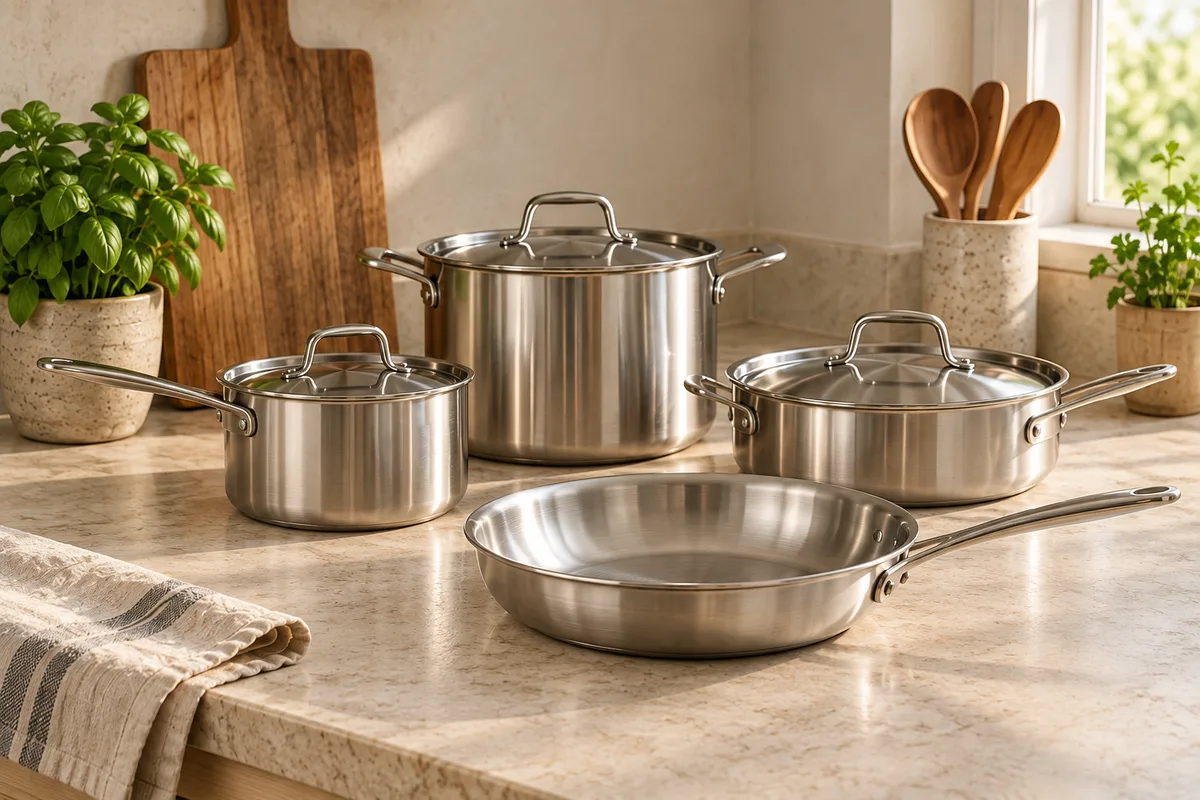
The best induction cookware fits both your stove and the way you cook. A huge set can still leave you short of the one pan you need. I would start with the size of your burner, the meals you make, and the weight you can lift with ease.
For most kitchens, I favor clad stainless steel. It can sear meat, simmer sauce, and move into the oven. Cast iron is a strong partner for a good crust. Nonstick pans make sense for eggs, but I would not make a large coated set my first purchase.
The best induction cookware at a glance
| Cookware set | Who I would choose it for |
|---|---|
| All-Clad D3, 10 pieces | Most cooks who want a lasting steel set |
| Tramontina Signature Tri-Ply Clad, 8 pieces | A small kitchen with a tighter budget |
| Made In Stainless Clad, 10 pieces | Cooks who want a rounded pan for sauces |
| Cuisinart MultiClad Pro MCPS-12N, 12 pieces | A first full set with sealed rims |
| Demeyere Industry 5, 10 pieces | Cooks who prefer smooth pan interiors |
| GreenPan Valencia Pro, 11 pieces | Low to medium heat and easy food release |
| Lodge Seasoned Cast Iron, 5 pieces | Searing, baking, and a heavy Dutch oven |
Piece counts include lids. An eight-piece cookware set is not eight pots and pans. Check the list of vessels before you compare prices.
1. All-Clad D3: my pick for most kitchens
I recommend the All-Clad D3 10-piece set for cooks who want a clear, useful mix of pans. This version has 8- and 10-inch frying pans, two saucepans, a sauté pan, and a stockpot. The four lids complete the set.
The three bonded layers run through the base and sides. Steel gives you a tough cooking surface. An aluminum core helps spread heat. That is a useful mix for an induction cooktop, where heat enters through the pan base.
I like this selection for a two-pan dinner. You can sear in a frying pan while a saucepan holds rice or sauce. The 8-quart stockpot gives you room for soup. There is no nonstick coating to plan around.
The key tradeoff is the handle. In this discussion of All-Clad handles, some owners like the secure shape; others find it awkward. Those views vary across hands and models. I would hold the exact pan before buying a full set.
D3 is rated for the oven and broiler up to 600°F. The current care rules call for hand washing. I would also want a larger frying pan if I cooked meat for four at once.
Best fit: A steel set for daily meals, with a useful range of pot sizes.
Main limit: The handles and 10-inch largest frying pan will not suit every cook.
2. Tramontina Signature: best for a smaller kitchen
I would put the Tramontina Signature Tri-Ply Clad set on a small-kitchen shortlist. Select the eight-piece version for this comparison. It includes two frying pans, 2- and 3-quart covered saucepans, and a 5-quart covered Dutch oven.
The Dutch oven is stainless steel, not cast iron. That matters if you want a pot for soup, pasta, or beans without buying a heavy iron pot as well. The two frying pans measure 8 and 10 inches across the rim.
This is fully clad stainless steel cookware with an aluminum core. It works on an induction cooktop, gas, and other listed stove types. The steel-lid set has a 500°F oven limit. Do not apply that limit to a different set with glass lids.
I like the smaller vessel count for a couple or one cook. Each pan has a clear job. I would skip it for large batches if a 5-quart pot already feels cramped. A bigger set can be useful, but only if you have room for it.
Tramontina lists the set as dishwasher safe and favors hand washing for care. I would use a soft pad and let pans cool first. Stock can vary by set size, so check the selected eight-piece version before paying.
Best fit: Core pots and pans without a large cupboard commitment.
Main limit: The largest pot and frying pan may be too small for a large family.
3. Made In Stainless Clad: best for sauce lovers
The Made In Stainless Clad 10-piece set earns its place through its pan shapes. This US-made version includes a 3-quart saucier. Its rounded lower sides help a whisk reach the edge when you stir a sauce.
You also get 8- and 10-inch frying pans, 2- and 4-quart saucepans, and an 8-quart stock pot. Four lids bring the count to ten. This is a five-ply cookware set, with bonded metal layers through the base and walls.
I would choose it over D3 if making sauces was a big part of my week. A saucier is useful for custard, gravy, or a small batch of risotto. I would favor a straight-sided sauté pan instead if I often cooked broad, shallow one-pot meals.
The set works on induction, gas, and electric cooktops. Made In gives this steel cookware an 800°F oven limit and prefers hand washing. That high oven limit is not a reason to blast an empty pan on an induction burner.
On the product page, buyer Kelli M. reports even heating on a new induction cooktop. I treat that as one owner's experience. It does not tell us how each pan will behave on every burner.
Best fit: Cooks who want a saucier as part of their main steel set.
Main limit: The set has no broad, straight-sided sauté pan.
4. Cuisinart MultiClad Pro: best first full set
I would compare the Cuisinart MultiClad Pro MCPS-12N with Tramontina before spending more on a first set. The current 12-piece version has sealed rims, steel lids, and riveted steel handles.
The closed rim is worth a look if you want dishwasher-safe cookware. Older MultiClad Pro listings and manuals can describe a different build. Use the model code, MCPS-12N, to check the set in your cart.
Its three-ply body has an aluminum core. Cuisinart lists induction compatibility and a 500°F oven limit for the current set. I would use that limit, even if an old review gives a higher one.
A steamer insert adds a useful job without another powered kitchen appliance. It also takes up space. If you rarely steam food, count it as a spare part when you judge the price. The same goes for lids that fit pots you will barely use.
This is my practical starting point for someone leaving a worn nonstick cookware set behind. Steel asks for some heat control and a bit of oil. In return, you get pans for browning, boiling, and making sauces without a coating to preserve.
Best fit: A first full steel set with sealed rims.
Main limit: The extra pieces only add value if you use and store them.
5. Demeyere Industry 5: best for smooth interiors
I would pay more for the Demeyere Industry 5 10-piece set if rivets inside a pan bothered me. Its welded handles leave a smooth cooking surface. There are fewer small edges to work around with a sponge or spoon.
The five-ply build runs from rim to rim. The set has 9.5- and 11-inch frying pans, 2- and 4-quart saucepans, a 3-quart sauté pan, and an 8-quart stockpot. Four steel lids complete it.
I like the larger frying pans and the mix of deep and shallow vessels. The sauté pan is a good shape for chicken with sauce. The stockpot suits a large batch of soup. That is a useful spread if several people share dinner.
The steel has Demeyere's Silvinox surface treatment. It is not a nonstick coating. Food can still stick, and the pans still need sound heat control. More layers do not make a cooktop's small coil cover a huge pan.
The set is induction compatible, dishwasher safe, and rated for the oven and broiler to 500°F. Lift a full pan before committing to this substantial set. Check stock, too; the maker's ten-piece listing can sell out.
Best fit: Cooks who value smooth interiors and a larger pair of frying pans.
Main limit: A high price and substantial weight.
6. GreenPan Valencia Pro: best for gentle nonstick cooking
I would choose GreenPan Valencia Pro for someone who cares most about easy food release. The 11-piece gray set pairs a ceramic nonstick surface with hard-anodized aluminum bodies and an induction-ready base.
The base is the part that lets these aluminum pans work on an induction cooktop. Plain aluminum cookware would not do the same job. GreenPan calls its base Magneto. The pan body and coating serve different roles.
This is the cookware set I would consider for eggs, pancakes, and meals made at low to medium heat. I would still keep an uncoated pan for hard searing. A full nonstick set ties many daily tasks to the life of its coatings.
The listed oven limit is 600°F for the pans and 425°F for the glass lids. Neither figure is a target for routine frying. GreenPan recommends hand washing and silicone tools, even though it lists dishwasher and metal-utensil compatibility.
I would follow that gentler care route. Let the pans cool, wash off oil residue, and avoid scraping. Easy release today does not promise the same surface years later.
Best fit: A cook who values low-effort release and will treat the coating gently.
Main limit: I would not buy the whole set for frequent high heat cooking.
7. Lodge Seasoned Cast Iron: best for searing and baking
The Lodge Seasoned Cast Iron 5-piece set is my choice for a cook who wants iron for several jobs. It includes 8- and 10.25-inch skillets, a 10.5-inch round griddle, and a 5-quart Dutch oven with a lid.
The cast iron skillet is the draw for seared meat and browned edges. The Dutch oven adds bread, braises, and oven meals. I would use the griddle for flat foods when its base fits the induction burner well.
Cast iron cookware retains heat well. That helps when cold food hits a hot pan, but it also means a lower stove setting will not cool the iron at once. Preheat in stages. Give the heat time to spread through the pan.
The set weighs about 28 pounds in total. Each piece is hand washed, dried, and lightly oiled. This is a real care commitment if you are used to loading everything into a dishwasher.
Lodge's guide to cast iron on induction stresses burner fit and lifting pans instead of sliding them. I would take that advice seriously on a glass cooktop.
Best fit: Searing and baking, with a cast iron Dutch oven in the mix.
Main limit: Heavy pans, hands-on care, and slower changes in heat.
What matters most on an induction cooktop?
Induction cooking heats a suitable pan through a magnetic field. The stove and pan work as a pair. A costly set with the wrong base size can be less useful than a modest pan that fits well.
The US Department of Energy explains how induction heats cookware directly. The glass can still get hot from the pan above it. Treat the surface as hot until it has cooled.
Check the base with a magnet
Hold a magnet against the underside of a cool, clean pan. A firm grip is a useful first check. Look for the maker's induction-compatible label as well. Then compare the base size with your cooktop's guide.
The magnet test does not measure heat distribution. Nor does it show how a pan will sit when hot. It tells you something about the metal, not the quality of the whole cookware set.
Non-magnetic stainless steel will not work on its own. Many steel pans solve this with a magnetic outer layer. Aluminum and copper pans need a suitable base as well. Plain glass cookware is not a choice for a standard induction cooktop.
A steel label alone is not enough. Check older pots one by one before replacing all your cookware. You may already own good induction compatible cookware.
Match the flat base to the burner
Measure the flat bottom, not just the rim. A pan sold as 12 inches can have a much smaller base. Your cooktop manual may give a minimum size that the burner can detect.
An oversized pan on a small coil can heat more in the center. A good metal core can spread heat, but it cannot erase every mismatch. Stirring and a slower warm-up help; the right pan size helps more.
I would check the largest frying pan and the smallest saucepan first. They are the pieces most likely to push the limits at either end. A small pan that the stove will not detect is no bargain.
Look for a stable base without deep damage or obvious rocking. A used pan should sit well on a flat surface. Check it cold before cooking, and use the return period to resolve a poor fit.
Choose weight you can handle
Heavy cookware can hold more heat, but that is only useful if you can move it safely. Add food and water to the mental picture. An empty stockpot is the easy part.
I would look for a helper handle on a large pan. Test the grip with an oven mitt. Check whether long handles clash when two pans share the induction cooktop.
The best stainless steel cookware is not always the thickest cookware. A lighter pan may be the right choice for a small meal or a wrist that tires quickly. Fit matters more than a layer count.
Read the care rules before buying
Oven safe, broiler safe, and dishwasher safe are separate claims. A pan can meet one and fail another. Glass lids often have a lower heat limit than the pan below them.
I would write down those limits when the cookware arrives. Keep the model's care sheet. That is more reliable than a general rule for all stainless steel pans or all ceramic nonstick pans.
If easy cleanup drives the purchase, be honest about your habits. A hand-wash-only set is a poor fit if no one will hand wash it. The right cookware is the cookware you can care for week after week.
Stainless steel, cast iron, carbon steel, or nonstick?
I would build around the food you cook most. One material does not need to do every job.
| Material | Main strength and tradeoff |
|---|---|
| Clad stainless steel | Broad use and no coating; needs oil and heat control |
| Seasoned cast iron | Strong heat retention; heavy and slow to cool |
| Carbon steel | Useful for frying; needs seasoning and gradual heat |
| Enameled cast iron | Good for slow wet meals; heavy, with enamel to protect |
| Induction-ready nonstick | Easy release; a coating that needs gentle care |
Stainless steel for a main set
Stainless steel cookware suits boiling, browning, and most sauces. A fully clad pan carries its layers up the sides. A disc-base pan puts its heat-spreading layer mainly underneath. Both designs can work on induction if the base is suitable.
I favor fully clad cookware for a mixed set because the sides help during tasks such as reducing sauce. But I would not reject a sound disc-base stockpot just for boiling pasta. Spend where the pan's shape and heat control help your meals.
Food release takes practice on steel. Use a moderate preheat, add the right amount of oil, and give food time to brown before turning it. Do not keep raising the heat because the food has not let go yet.
Cast iron and carbon steel for frying
A cast iron skillet is useful when you want the pan to retain heat. Carbon steel pans often give you a similar style of cooking in a thinner pan. Actual weight still depends on the model and size.
Both need seasoning, a thin baked-on layer of oil. That layer can help food release. It is not the same as a factory nonstick coating, and it needs care after washing.
I would warm cast iron and carbon steel pans slowly on an induction cooktop. A fast blast into a small part of the base can stress the pan. Empty carbon steel pans are not a good match for the boost button.
For a long tomato simmer, I would choose steel or enameled cast iron over bare seasoned iron. An enamel coating changes the care needs. Do not scrape it with metal tools or treat a chip as normal wear.
Nonstick for a specific job
I would buy nonstick cookware for easy eggs or delicate fish. I would not buy it to cover every task from hard searing to years of oven meals.
An induction-ready nonstick pan needs a magnetic base, whatever its coating is made from. Ceramic coating does not itself make a pan work on an induction stove. Look at the base and model details.
A nonstick surface also needs a lower-heat mindset. Use wood or silicone tools, avoid stacking bare pan interiors, and follow the maker's cleaning rules. When the coating is badly damaged or no longer works, replacing one pan costs less than replacing a whole set.
Buy a cookware set or only two pans?
If you cook simple meals, I would start small. A medium frying pan and a covered saucepan can handle a lot. Add a large pot when soup or pasta becomes a regular job.
A set makes sense when you need most of its vessels at once. Compare the price of those useful pieces with the bundle. Lids, small frying pans, and steamer inserts can make the box sound bigger than it is.
For batch cooking, think about storage as well as stove space. A big pot of food needs sensible portions afterward. These meal prep containers for work and home help match a batch to the fridge, freezer, or lunch bag.
Keep some counter space free, too. A pan rack, kettle, and one of the home espresso machines in this guide can soon crowd a small kitchen. Buy for the space you have, not the kitchen in a showroom.
How to care for induction cookware
Start on low or medium settings while you learn the new stove. Induction may heat a pan much faster than the gas stoves or electric stoves you used before. Do not leave an empty pan on high heat.
Lift pans across the glass top. Wipe grit from the base and spills from the cooled cooktop. A heavy cast iron skillet deserves the same care as a polished steel frying pan.
Let hot cookware cool before washing it. Cold water on a very hot base creates a sharp change in heat. Use the cleaner and pad type the maker allows.
Dry steel after washing if water spots bother you. Dry seasoned cast iron and carbon steel promptly, then apply a thin film of oil. Do not leave them soaking in the sink.
For nonstick pans, clear away cooked-on oil gently. More heat and harder scrubbing can turn a small cleanup job into coating damage. Treat a stubborn stain as a care question, not a reason to reach for a sharp tool.
Quick answers before you choose
Will induction cookware work on a gas stove?
Often, yes. All seven sets here list broad stovetop use. Check each model, especially if it has a coating, special handle, or unusual base. A pan that works on gas may still fail on induction if its base is not magnetic.
Does five-ply always beat three-ply?
No. Layer thickness, metal choice, base size, and handle shape matter. I would compare the whole pan. A useful three-ply cookware set can be a better purchase than a five-ply set with the wrong sizes.
Can a Dutch oven replace a stockpot?
For some meals, yes. Check capacity and weight. A 5-quart Dutch oven gives you less space than an 8-quart stockpot. A cast iron Dutch oven is also much heavier to drain. I would choose by the meal and the lift, not the name.
Which induction cookware would I buy first?
I would start with All-Clad D3 if the handle and price fit. I would compare Tramontina and Cuisinart for value. Add cast iron or one nonstick pan only when it fills a real gap. The best induction cookware is a useful set of tools, not the largest box.